
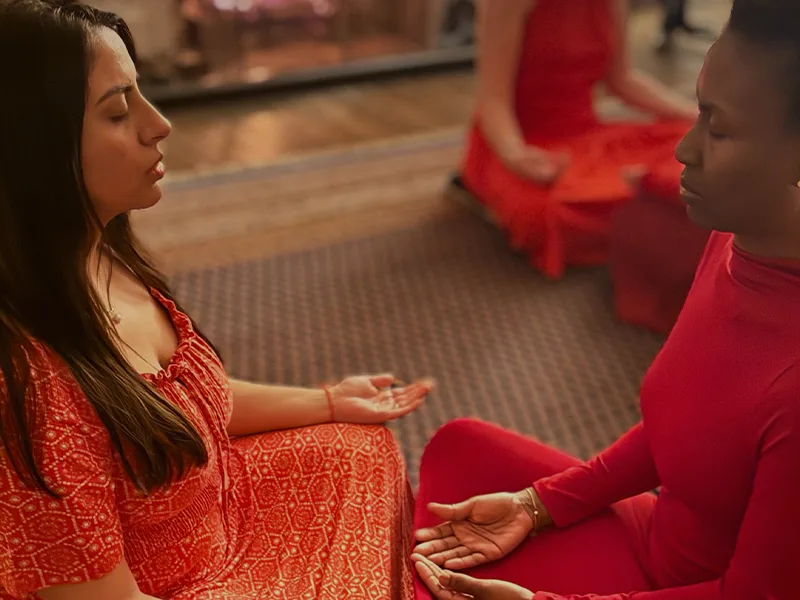
Exploring body image, intimacy and sexual energy through Tantra
People, how much time do we spend worrying about our bodies?
Am I attractive enough? Are my breasts too small? Is my stomach too big? Is my lingam the right size? Do I look good naked? Will my partner find me attractive?
Then there are all the expectations surrounding intimacy. Am I good enough in bed? How long should I last? Should I be making certain sounds? Am I pleasing my partner? Am I doing everything correctly?
Goodness me, when did intimacy become such an examination?
These questions may sound amusing, but they reveal something important about our relationship with ourselves. Many people experience insecurity about their appearance, their sexuality and their ability to satisfy a partner.
We spend so much time looking at ourselves through the imagined eyes of others that we sometimes forget how to experience our own bodies.
I want to explore this through Tantra, particularly the relationship between body image, sexual desire, spiritual awareness and the way we have been conditioned to understand intimacy.
The body we see and the body we experience
From an early age, we begin forming ideas about what makes a body attractive.
We see images in films, advertisements, pornography and social media. We hear comments about weight, skin colour, breast size, muscularity, genital appearance and countless other physical characteristics.
Over time, these messages can influence how we perceive ourselves.
A person may have a perfectly healthy body and still feel deeply uncomfortable with their appearance. Someone else may spend years pursuing a particular physique, believing that achieving it will finally make them feel confident.
But where does that sense of inadequacy come from?
Sometimes it comes from experiences of rejection, criticism or comparison. Sometimes it develops through repeated exposure to unrealistic ideals. Our psychological relationship with our appearance can become remarkably complicated.
There is also a difference between everyday body insecurity and body dysmorphic disorder, a recognised mental health condition involving persistent distressing preoccupation with perceived flaws in appearance.
We should take these experiences seriously rather than assuming that everyone simply needs more confidence.
What interests me spiritually is the extent to which we identify ourselves with our physical appearance.
We look into a mirror and immediately begin judging. Too much of this, not enough of that or I wish this were different.
But how often do we simply observe ourselves without criticism?
Intimacy and the pressure to perform
Let's talk about sex.
For something so natural to human existence, we have managed to surround it with an extraordinary amount of expectation.
Pornography has become one source through which people learn about sexual behaviour. Yet much of what we see is produced for entertainment, often presenting unrealistic bodies, exaggerated responses and carefully constructed performances.
Of course, people respond to pornography differently. Some enjoy it without experiencing difficulties, while others find that their viewing habits influence their expectations, relationships or sexual wellbeing.
My concern is what happens when we begin comparing our intimate experiences with what we see on a screen.
Suddenly, intimacy becomes something we feel we must perform.
We start thinking about how we look, how long we last, whether we're doing enough and whether our partner is satisfied.
Where is our awareness in all of this?
We can become so occupied with evaluating ourselves that we lose the ability to experience the moment. I often wonder how much pleasure people actually experience when their attention is consumed by anxiety.
And this is where I find the Tantric perspective particularly interesting.
Seeing the body through Tantra
Within many Tantric traditions, the body has an important place in spiritual practice.
The body is involved in our experience of consciousness, breath, sensation, emotion and awareness. Certain Tantric teachings invite practitioners to recognise the sacred within embodied existence.
In my own practice, devotion to Shiva and Shakti has profoundly influenced how I understand the body and intimacy.
Imagine looking at your partner with reverence.
Imagine recognising Shakti or Shiva within the person before you.
How might that change the way you approach touch, affection and sexual intimacy?
Perhaps you become less concerned with appearance and more attentive to the person.
Perhaps you begin noticing their breath, their emotions, their responses and the quality of your connection.
Perhaps you also become more aware of your own thoughts and insecurities.
This is something I find beautiful about Tantra. It invites us to examine the relationship between our inner experience and the world around us.
Of course, Tantra encompasses many traditions, and sexual practices form only a small part of that wider spiritual landscape.
For me, the deeper question is how we bring awareness into everything we experience.
Desire, stimulation and awareness
There is another aspect of modern intimacy that interests me.
Our relationship with stimulation.
We live in a world where entertainment, communication and gratification are often immediately accessible. We can scroll through hundreds of images within minutes, move rapidly between different forms of entertainment and seek another experience almost as soon as the previous one has ended.
Sexual stimulation can become part of this pattern.
Now, I don't believe we should automatically condemn pleasure or masturbation. Sexual desire is part of human experience, and people have different relationships with it.
What I would encourage is awareness.
Are we acting through genuine desire, curiosity and enjoyment? Or are we responding automatically to boredom, stress, loneliness or emotional discomfort?
Do we feel free to choose, or do we feel compelled to repeat the same behaviour?
There is a considerable difference between consciously enjoying an experience and feeling unable to step away from it. This is where I find the practice of witnessing particularly valuable.
We can observe desire as it arises without immediately judging it or acting upon it and can notice the sensations within the body, the thoughts within the mind and the emotions accompanying them.
Sometimes that awareness alone changes our relationship with the experience.
Brahmacharya and the conservation of sexual energy
Brahmacharya is often associated with celibacy, although its meaning and practice vary across spiritual traditions.
For some practitioners, it involves complete sexual abstinence. For others, it concerns restraint, moderation and the conscious direction of one's energies towards spiritual practice.
Within traditional Indian thought, Ojas is associated with vitality and spiritual strength, although its interpretation differs between Ayurvedic and yogic teachings.
I find these concepts fascinating because they encourage us to examine how we use our attention, energy and desire.
We can ask ourselves whether our habits support the life we wish to lead.
Are we constantly seeking stimulation?
Do we feel exhausted by our routines?
Can we cultivate patience, discipline and greater awareness?
These are worthwhile questions regardless of whether someone chooses celibacy, sexual intimacy or another approach.
I would be cautious about interpreting Ojas as a scientifically measurable quantity of sexual energy that permanently disappears through ejaculation. The traditional teachings deserve to be understood within their own philosophical contexts.
For me, the practical value lies in learning to direct our attention consciously rather than feeling controlled by every impulse.
What about Tantric intimacy?
In certain Tantric approaches, intimacy may involve meditation, breathwork, conscious touch and devotional practices.
The symbolism of Shiva and Shakti can provide a profound spiritual framework for understanding union.
Yet there is no single universal method of Tantric sex, and not every Tantric tradition involves sexual ritual.
Within my own work, I encourage people to explore the quality of their awareness.
• Can you remain present with your partner?
• Can you communicate your feelings and boundaries openly?
• Can you experience touch without constantly anticipating what should happen next?
• Can you appreciate intimacy without making orgasm the sole measure of a successful experience?
These questions can reveal a great deal about our relationship with pleasure.
Sometimes we become so concerned with reaching an outcome that we overlook everything happening along the way.
Breathing, touch, affection, tenderness, emotion and simply being together can all become meaningful parts of intimacy.
There is no need to turn every intimate encounter into a spiritual achievement.
Awareness itself is worth cultivating.
The body as a temple
I often speak about the body as a temple.
But what does that actually mean?
For me, it begins with respect. Respect for our physical health, emotional wellbeing, personal boundaries and the way we treat ourselves.
It also involves recognising how our habits affect our state of mind. I enjoy physical activity, yoga, pranayama, meditation and spending time in nature. These practices help me maintain a relationship with my body that extends beyond appearance.
Exercise can support strength and health. Yoga can encourage awareness of breath, movement and attention. Meditation provides opportunities to observe our thoughts and emotional responses.
Then there is something equally important about how we create our home environment. Eating together, having meaningful conversations, laughing with family, sharing concerns and making time for one another can all contribute to our wellbeing.
A spiritual life does not have to be separated from these everyday experiences. Sometimes the most meaningful practice is simply giving someone your complete attention.
Learning to witness ourselves
I want to return to the questions we began with.
Am I attractive enough?
Is my body the right shape?
Am I good enough for my partner?
What happens when these thoughts arise?
Usually, we respond by comparing, criticising or trying to change something.
But what if we first observed the thought?
Where did it come from?
Whose expectations are we trying to satisfy?
Is this something we genuinely believe, or something we have absorbed over time?
Through meditation and self enquiry, we can begin recognising these patterns. This does not mean that every insecurity disappears through spiritual practice. Some experiences, particularly persistent body image distress, may require psychological support.
But awareness can help us recognise the stories we repeatedly tell ourselves and perhaps we can begin relating to our bodies with greater compassion.
A final reflection
I believe we have much to learn about our relationship with desire, intimacy and the human body.
There is tremendous value in exploring the teachings of Tantra, Brahmacharya and the spiritual significance of Shiva and Shakti.
Yet these teachings also invite personal reflection.
We can study the scriptures, practise meditation, explore our breath and cultivate awareness. We can question the expectations we have inherited and examine how they influence our relationships.
Most importantly, we can begin to recognise how much of our experience is shaped by the mind.
The body we spend so much time judging is the very body through which we experience life.
How extraordinary is that?
Perhaps the next time you look into a mirror, you might spend a moment simply observing.
Without comparison. Without immediately searching for something to correct.
Just you, as you are.
Love and light,
Hari xox